Introduction: The Cards Are Being Redealt in the Tech World
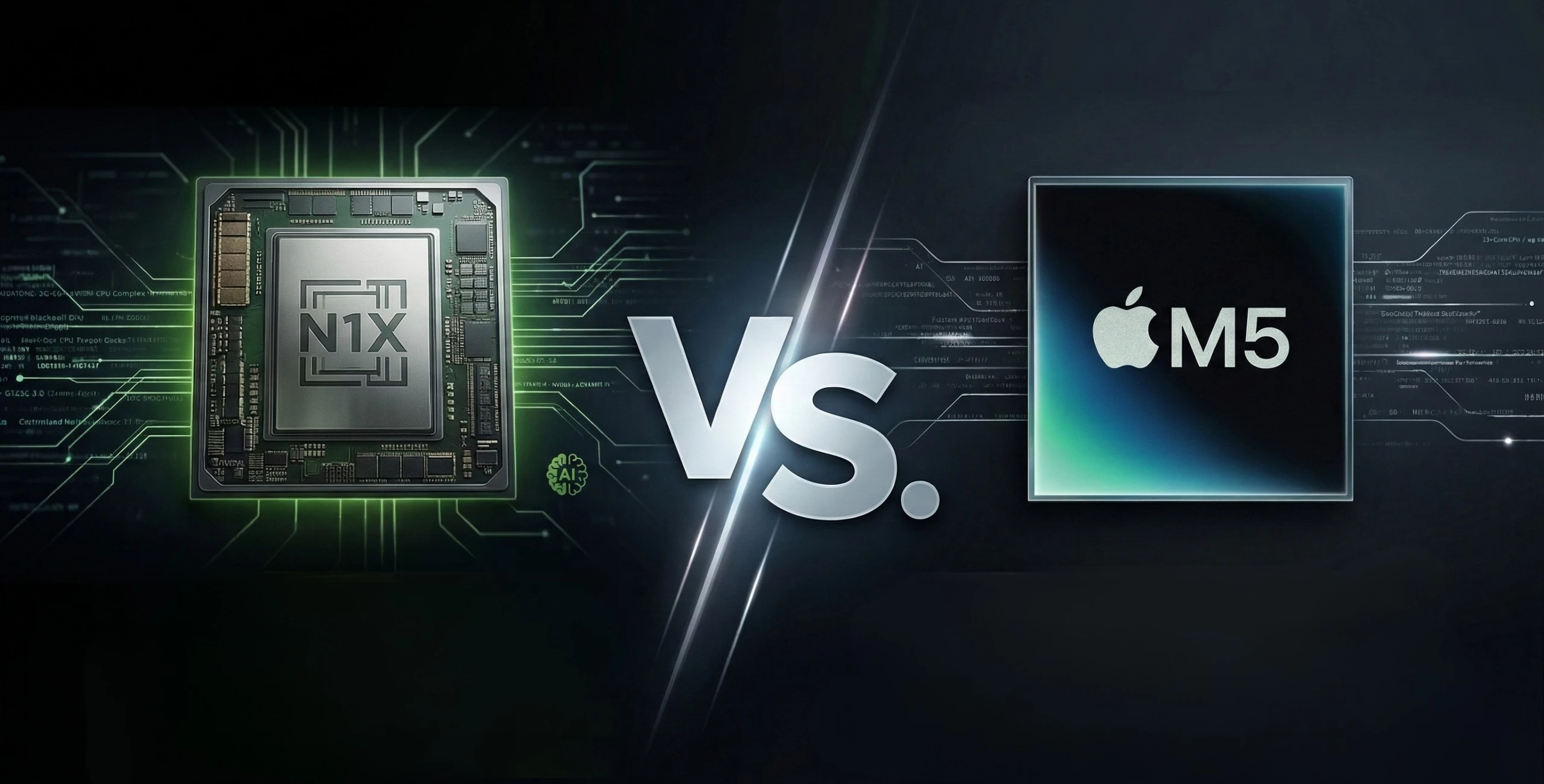
Hello tech enthusiasts! Today, I want to talk to you about the NVIDIA N1X vs. Apple M Series showdown, which is the biggest and most exciting hardware rivalry we’ve seen in recent years. For a long time, the balance in the laptop market has constantly shifted between Intel, AMD, and Apple. But as we enter the spring of 2026, the game is moving to an entirely new dimension. On one side, we have Apple, the undisputed king of its own ecosystem, which just introduced its brand-new M5 series. On the other side, we have NVIDIA—the architect of the AI revolution—getting ready to unleash its long-rumored, closely guarded ARM-based N1X processor.
Let me put into perspective just how serious this situation is: March 2026 will go down in history as the month the rules for ultra-thin laptops were completely rewritten, giving true meaning to the “AI PC” concept. While Apple’s new devices hit the shelves starting March 11 , NVIDIA is preparing a massive counterattack at the GTC 2026 event in San Jose from March 16 to 19. I’ve dug deep into the details of this historic rivalry and laid out all the facts just for you.
Apple M5 Series: Raising the Bar in the Mac World
First, let’s look at Apple’s camp. When I analyze the newly announced M5 Pro and M5 Max chips, I can see that the company is truly pushing the boundaries with what it calls the new “Fusion Architecture,” which combines two 3nm dies into a single System on a Chip. Just imagine this: the M5 Max model boasts an 18-core CPU and a massive GPU with up to 40 cores. What fascinates me the most—and what will definitely thrill anyone running local Large Language Models (LLMs)—is a major hardware shift. Apple has now embedded a dedicated “Neural Accelerator” inside every single GPU core. Thanks to this innovation, peak AI compute performance is more than four times higher compared to the previous M4 generation.
When we look at performance tests, the M5 chip is breaking records. In the Geekbench 6 database, it achieved an incredibly high single-core score of 4,263, which is a record that is currently unmatched by any Mac or PC processor. The hardware optimization is so flawless that the 16-inch model can deliver up to 24 hours of battery life. However, when it comes to your wallet, Apple maintains its classic luxury strategy. The 14-inch M5 Pro model starts at $2,199, while those seeking top-tier performance will have to shell out at least $3,599 for the 14-inch M5 Max. Sure, bumping the base storage up to 1TB and 2TB is a nice consolation prize, but there’s no denying these machines sit firmly in the premium luxury segment.
NVIDIA N1X: The Unexpected Move Rewriting the Rules
So, what about NVIDIA? We’ve been talking for a while about how the company wouldn’t just settle for making dedicated graphics cards; they are bringing their cloud and server dominance straight to the consumer’s laptop. NVIDIA’s CEO, Jensen Huang, personally promised to unveil a chip that will “surprise the world” at the GTC 2026 event. Strong industry leaks confirm that this is the N1X SoC (System on a Chip), developed in a strategic partnership with MediaTek.
Personally, just looking at the hardware specs on paper is enough to get me excited. The N1X features a massive 20-core ARM-based CPU complex, heavily utilizing powerful Cortex-X925 cores. In leaked Geekbench 6 tests, it has already proven its strength, scoring 3,096 in single-core and an impressive 18,837 in multi-core performance. While it might trail slightly behind Apple in single-core speeds, what makes NVIDIA truly special is its graphics and AI capabilities. Inside the N1X lies an integrated GPU based on the Blackwell architecture, packing a whopping 6,144 CUDA cores—equivalent to a desktop RTX 5070 graphics card.
The Gaming and AI Clash : NVIDIA N1X vs. Apple M Series
When I compare the architectural philosophies of these two tech giants, I see completely diverging strategies. Apple aims to move massive datasets rapidly by offering a colossal 614 GB/s of memory bandwidth with the M5 Max. NVIDIA, on the other hand, steps onto the battlefield with raw compute power, next-generation FP4 tensor cores capable of hundreds of trillions of operations per second (TOPS), and its unrivaled, mature CUDA ecosystem. Keep in mind, the vast majority of AI software today is optimized primarily for CUDA, giving NVIDIA a massive advantage.
As a gamer and tech critic, the issue I care about most is gaming performance in the Windows environment. Running legacy x86 Windows games on an ARM architecture usually results in severe performance drops due to emulation overhead. But this is where NVIDIA’s engineering brilliance shines. They are bringing DLSS 5.0 frame generation technology to the table, and it runs entirely on the N1X’s dedicated Neural Processing Unit (NPU). While Apple’s NPU is too slow for frame generation—forcing the GPU to handle upscaling tasks —NVIDIA offloads DLSS completely to the NPU.
This means even if the CPU struggles during ARM translation, DLSS 5.0 flawlessly inserts the missing frames, delivering perfectly smooth gameplay even in the heaviest titles. Furthermore, Microsoft is rolling out a specialized “Bromine” version of Windows 11 (version 26H1) explicitly optimized for next-gen ARM chips like the N1X and Snapdragon X2 to ensure maximum software support.
Market Dynamics and My Final Thoughts
To sum it all up, the first half of 2026 is an absolute festival for tech enthusiasts like us. According to supply chain reports, major manufacturers like Dell (likely with the XPS and Alienware series) and Lenovo (with Legion and Yoga series) are preparing to launch N1X-powered laptops very soon. In my opinion, if you’ve been dreaming of a Windows laptop that is as incredibly thin as a MacBook, has an all-day battery life, but still packs the monstrous gaming and AI power of NVIDIA, the N1X looks like the only key to making that dream a reality.
Without a doubt, Apple’s M5 series will remain a phenomenal tool for professional creators and loyal Mac users, and they won’t easily surrender their lead in raw single-core performance. However, NVIDIA’s aggressive N1X move—combining hardware, software, and AI brilliance into a single, sleek chassis—is going to be the biggest disruption the laptop status quo has seen in years. I am eagerly counting down the days to the GTC 2026 event; welcome to a brand new era where competition and innovation ultimately benefit us, the users!

 Veysel Okatan