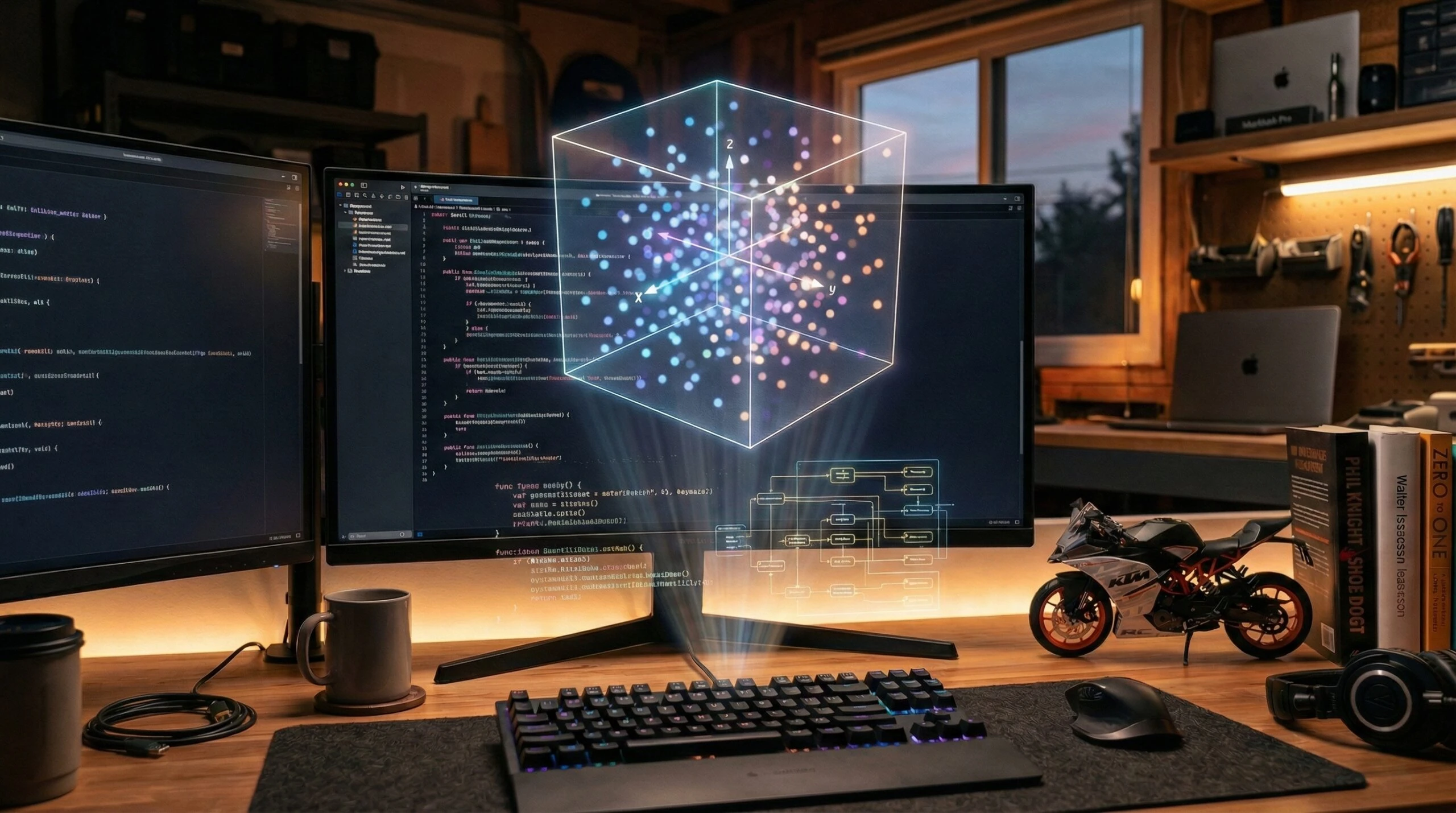
The tech world is currently obsessed with one polarizing question: “Is coding dead?”. With the rise of advanced generative models, the “manual labor” of writing syntax, boilerplate structures, and repetitive debugging is rapidly evolving. However, while the traditional way of coding might be fading, the era of Value Creation and Architectural Thinking is just beginning.
The 1% Data Loss: The Hidden Trillion-Dollar Opportunity
Our current computing systems are trapped in a binary cage, struggling to represent the infinite complexity of reality between 0 and 1. When a processor handles a repeating value like $0.3333…$, it eventually rounds the number to preserve memory.
This technical compromise results in what I call the “1% Data Loss”. While it seems insignificant for a single calculation, this loss compounds across billions of operations. I believe that the world’s most profound unsolved problems—specifically NP-Complete challenges—remain unsolved precisely because the answers are hidden within that discarded 1% of data.
Breaking the Binary: Storing Data in the Probability Cube
To overcome these hardware limitations, we need to rethink how we store and process information. My proposed solution involves a shift from rounded bits to spatial coordinates within a 3D Probability Cube. This is where the question of “is coding dead” finds its real answer: the code isn’t dying; it is becoming multi-dimensional.
By applying the logic of Quantum Computing states—where a value can exist in any state between 0 and 1 simultaneously—we can bypass the memory bottlenecks of modern hardware. Instead of forcing a number to “be” a specific bit, we allow it to exist as a probability within a spatial coordinate.
Why “Is Coding Dead” is the Wrong Question for Architects
Software development hasn’t ended; it has simply changed direction from the keyboard to the mind. While building native projects like NeoTiler, I’ve realized that the real joy is no longer in writing the code itself, but in architecting the solution.
If you are a builder who understands system design, then for you, is coding dead? Absolutely not. It is just faster and more powerful. You can see my other projects and my vision on my About Us page.
Productive Hallucinations: Daring to Dream
We often label complex problems as “impossible” because we view them through the lens of current binary limitations. To build the next generation of software, we must engage in “Productive Hallucination”—the ability to dare to dream outside the box and visualize structures that don’t yet exist.
My personal motto has always been: “Anything I can architect and plan in my mind, I can build”. In this new era, if you can visualize a system and plan its architecture, the tools to manifest it are already at your fingertips. This is why I believe the answer to is coding dead is a resounding no for those who lead with their minds.
Moving Toward a Future of Pure Value Creation
The transition we are witnessing is a move toward Value Creation. In the past, a developer spent 80% of their time on syntax and 20% on the core problem. Now, that ratio is flipping. We are becoming “Mind Architects” who use AI as a high-performance engine to manifest our blueprints.
Final Thoughts on the Future of Development
As we move beyond the limits of 0s and 1s, the most successful developers will be those who stop worrying about syntax and start focusing on architecture and value creation. The future belongs to those who can see the trillion-dollar solutions hidden in the gaps of our current technology.

 Veysel Okatan